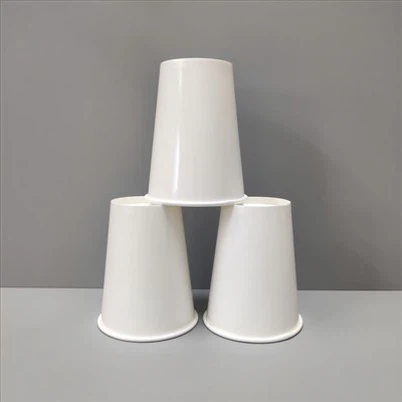
Are Your Paper Coffee Cups Really Safe To Drink From?
Leave a message
Are Your Paper Coffee Cups Really Safe to Drink From?
You enjoy your daily coffee in a paper cup. But you hear worrying news about microplastics and chemicals, making you question what's really in your morning brew.
Paper coffee cups are considered safe when they are certified "food-grade." This means they use clean virgin paper, safe inks, and linings tested under strict regulations to ensure chemicals or particles don't transfer into your drink at harmful levels.

Clients ask me this question all the time, and my answer is always the same: safety isn't an accident; it's a result of deliberate choices and rigorous processes. As a manufacturer with over 20 years of experience, I am legally and ethically responsible for every single cup that leaves my facility. It's far more complex than just sticking paper and a coating together. Let's pull back the curtain and look at exactly what goes into making a paper cup that you can trust, so you know the only thing you're tasting is your coffee.
What Are Paper Cups Actually Made Of?
You see a simple paper cup. But are the paper itself and the ink on it actually safe for your drink? The wrong materials could be a hidden source of trouble.
To be safe, cups must use "food-grade" virgin paperboard to avoid contaminants found in recycled paper. The inks on the outside must also be certified non-toxic and free from heavy metals.

The foundation of a safe cup is its paper. My top priority is always health, which is why we must use virgin paperboard. This is paper made directly from wood pulp, not from recycled materials. Why? Recycled paper can contain residues from its previous life, like inks, glues, or chemicals, which are not safe for direct contact with food. Using virgin pulp is the only way for me to guarantee a clean, non-toxic starting point.
The second part is the ink used for branding and design on the outside of the cup. These can't be just any inks. They must be specially formulated to be food-safe. This means they are stable and will not transfer through the paperboard. We specifically test to ensure they are free from harmful substances, especially heavy metals like lead and cadmium, which can be toxic even in very small amounts. Every element, even the one you don't drink from, is chosen with safety in mind.
Do Chemicals from the Lining Leak into Your Coffee?
That waterproof lining is essential, but you worry that hot coffee might cause it to release microplastics or other chemicals directly into your drink.
Studies show hot liquids can cause both plastic (PE) and bioplastic (PLA) linings to release micro- and nanoparticles. However, strict regulations exist to limit this migration to levels considered safe.

This is probably the biggest concern I hear about, and it deserves an honest answer. Since paper is absorbent, every cup needs a waterproof lining. The two most common types are Polyethylene (PE), a traditional plastic, and Polylactic Acid (PLA), a "bioplastic" made from plants. Recent studies have indeed shown that when hot liquid (like coffee) is poured into cups with these linings, they can shed a very large number of tiny particles-microplastics and even smaller nanoparticles.
While the long-term health impact of ingesting these particles is still being heavily researched by scientists worldwide, this is where regulations and quality control become critical. The primary safety concern that is regulated today is chemical migration. The worry is that chemicals from the lining's composition could "leach" or migrate into the beverage. Hot, acidic drinks like coffee can accelerate this process. This is exactly why we have strict standards and testing, which we will look at next.
Who Decides if a Paper Cup Is "Safe"?
You see the term "food-grade" everywhere. But you wonder who actually sets these rules. Is it just a marketing gimmick, or is there real enforcement and authority behind it?
Government bodies like the FDA in the United States and the EFSA in Europe set strict legal standards. They define what materials are safe and establish maximum limits for any substance migrating into food.

"Food-grade" is not a marketing term; it's a legal and technical certification. As a global supplier, I have to comply with the rules of the countries I ship to, and the two most important regulatory bodies are in the US and Europe. Their core principle is the same: nothing from the packaging should transfer to the food in amounts that could endanger human health or change the food's taste or smell.
| Regulatory Body | Region | Key Regulation | Core Principle |
|---|---|---|---|
| FDA | United States | Title 21 CFR | Materials and coatings must be made from approved substances. |
| EFSA | European Union | Regulation (EC) 1935/2004 | Sets strict "migration limits" on substances transferred to food. |
These organizations maintain extensive lists of approved substances that can be used in plastics, coatings, and paper that come into contact with food. If a material isn't on that list, I simply cannot use it. This framework ensures that even if microscopic migration occurs, the substances and their amounts are within levels that have been deemed safe for human consumption.
How Do We Actually Test Cups for Safety?
So there are strict rules for safety. But how does a manufacturer like me prove that our cups actually meet them? The proof lies in rigorous and repeated laboratory testing.
Cups undergo migration testing. They are filled with a hot liquid that mimics coffee and held at temperature. Scientists then analyze this liquid to ensure any leached substances are well below legal limits.

To certify our cups as food-grade, we can't just trust the raw material suppliers. We have to test the final product. Here's how it's done:
Migration Testing: This is the most critical test. In a lab, we fill a sample of cups with a "food simulant." This is a scientific liquid, often slightly acidic and hot, designed to mimic the properties of coffee. The cups sit for a specified time (e.g., one hour at 90°C). Afterward, chemists use advanced equipment to analyze the simulant. They are looking for specific chemicals and measuring their concentration down to parts per billion. The result must be far below the legal migration limit set by the FDA or EFSA.
Sensory Testing: We also test to make sure the cup doesn't make your coffee taste or smell like paper or plastic. Testers fill the cup with water and compare its taste and smell to a control sample from a glass container.
Material Analysis: We test the raw materials themselves to confirm they don't contain banned substances like heavy metals.
This multi-layered testing process is our ultimate quality-control check.
Conclusion
Generally, paper cups are safe. This safety is ensured by using certified food-grade materials and meeting strict government standards, all confirmed through rigorous lab testing before