

What To Look For When Buying Disposable Paper Cups In Bulk
Leave a message
What to Look for When Buying Disposable Paper Cups in Bulk
Placing a large order for disposable paper cups feels like a simple task until you're staring at a sea of nearly identical options. A wrong choice here doesn't just mean a minor inconvenience-it can lead to wasted thousands of dollars, operational headaches, and unhappy customers. The goal isn't just to buy cups; it's to invest in a reliable component of your daily operation.
When buying disposable paper cups in bulk, prioritize supplier reliability and sample testing, not just price. Key factors include confirming lining compatibility (PE vs. PLA) for your beverages, ensuring precise lid fit to prevent leaks, and verifying print quality and durability through real-world testing before committing to a large order.

Bulk purchasing removes the luxury of small-scale trial and error. The decisions you make before the purchase are your only insurance policy against receiving a pallet of underperforming products. Let's break down the critical checklist.
Beyond the Price Tag: Evaluating Supplier Reliability
The cheapest price per cup can become the most expensive mistake you make. A reliable supplier is your partner in quality and consistency, not just a vendor processing a transaction.
Supplier reliability is proven through consistent product quality, on-time delivery, and transparent communication. Look for manufacturers with verifiable certifications (like FSC for paper sourcing and BRC for production standards) and who are willing to provide detailed product specifications and sample kits before you buy.
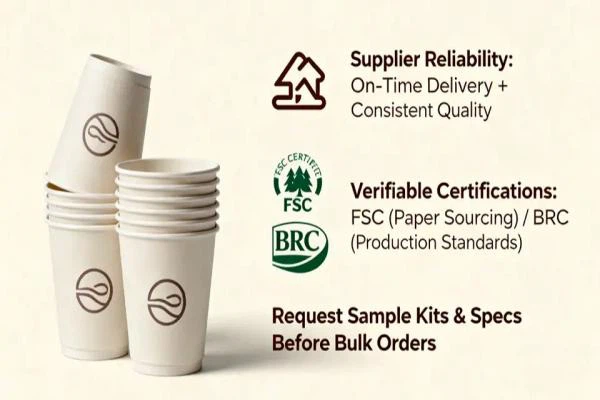
A low price means nothing if the cups arrive two weeks late, are damaged, or vary from your initial sample. The supplier's operational integrity is as important as the product itself.
Start by asking for their certifications. An FSC (Forest Stewardship Council) certification ensures the paperboard comes from responsibly managed forests, which is a baseline for environmental and ethical sourcing. A BRC (British Retail Consortium) or similar food-safe production certification is a non-negotiable proof that they operate under stringent hygiene and quality management systems. Next, gauge their responsiveness. A supplier that is slow to answer questions before the sale will be glacial when solving a problem after. Finally, demand a detailed product spec sheet. This document should clearly state the paper weight (e.g., 210gsm), lining type and thickness, and exact rim curl dimensions. This level of detail separates professional manufacturers from amateur traders and ensures you know exactly what you are paying for.
The Pre-Purchase Imperative: Rigorous Sample Testing
Never, ever place a bulk order without physically testing production samples. Your hands are the best quality control tool you have.
Rigorous sample testing involves evaluating the cup's performance under real-world conditions: pouring boiling water to check for leaks and seam strength, holding it to assess heat retention and comfort, and fitting the intended lid to ensure a secure, snap-on seal.

A sample isn't a souvenir; it's a prototype for your entire order. Put it through its paces as if you were in the middle of your morning rush.
Creating Your Own Quality Assurance Checklist
Treat the sample like a product test. Create a simple but methodical checklist to evaluate every critical aspect of performance. This turns a subjective feeling into an objective decision.
| Test | How to Perform It | What to Look For |
|---|---|---|
| Hot Liquid Test | Fill with near-boiling water, let sit for 5 minutes. | Check for leaks, especially at the side seam. Feel the outside for excessive heat. |
| Lid Fit Test | Secure the lid you intend to use. | It should snap on firmly without excessive force and should not pop off when squeezed. |
| Clarity of Print | Rub the printed logo vigorously with a damp cloth. | The ink should not smudge or transfer. Colors should be vibrant and aligned. |
| Strength Test | Crush the empty cup gently in your hand. | It should offer resistance and spring back, not collapse easily. |
| Stacking Test | Stack 10-20 cups together. | The stack should be stable, and the bottom cup should not deform. |
This hands-on testing is your primary defense against failure. For instance, testing heat retention will immediately show you the dramatic difference between a flimsy single-wall cup and an insulated double-wall option. The lid fit test is perhaps the most critical-an ill-fitting lid will cause more customer complaints than almost anything else. Remember, you are not just buying a disposable paper cup; you are buying a functioning system that includes the lid. This due diligence also helps you avoid the wrong product entirely. For example, if you need cups for hot coffee, testing will quickly show you that a PET plastic cups-which are clear, rigid, and designed for cold drinks-are unsuitable due to their lack of insulation and potential to warp with heat.
Navigating Specifications: GSM, Lining, and Logistics
Understanding the language of cup specifications empowers you to make informed comparisons and avoid marketing fluff.
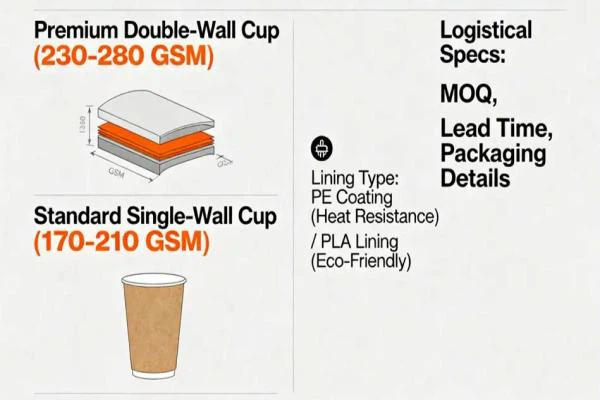
Key specifications to navigate include GSM (paper weight/thickness), lining type and application, and the logistical details of MOQ (Minimum Order Quantity), lead time, and packaging. A higher GSM (e.g., 230-280) indicates a sturdier, more premium double-wall cup, while a standard single-wall cup is typically 170-210 GSM.
These numbers and terms are the DNA of the product. Decoding them ensures you get the performance you pay for and aren't surprised by hidden costs.
GSM stands for Grams per Square Meter. It is a measure of paper density and weight. A higher number means a thicker, heavier paperboard. For a double-wall cup that needs to provide insulation and structural integrity, you should look for a GSM above 230. For a standard single-wall cup, around 190-210 GSM is common. The lining type must be explicitly stated. Confirm if it's PE (standard, recyclable in theory) or PLA (compostable, plant-based). Also, ask about the coating application process to ensure an even, complete barrier-a poor coating will lead to soggy cups. Finally, discuss logistics upfront. What is the MOQ? Is it by cup count or by pallet? What is the production lead time once artwork is approved? How are the cups packaged for shipment (e.g., 1000 per case, 10 cases per pallet)? Poor packaging can result in crushed cups upon arrival. Clarifying these details prevents misunderstandings and ensures a smooth delivery process for your bulk paper cup order.
Conclusion
Buying disposable paper cups in bulk successfully requires a shift from viewing them as a simple commodity to treating them as a critical business supply, demanding thorough supplier vetting, hands-on sample testing, and a clear understanding of technical specifications. For businesses seeking a partner that simplifies this process with transparency, quality assurance, and expert guidance, Amity Packaging offers reliable bulk solutions tailored to your specific operational needs.


